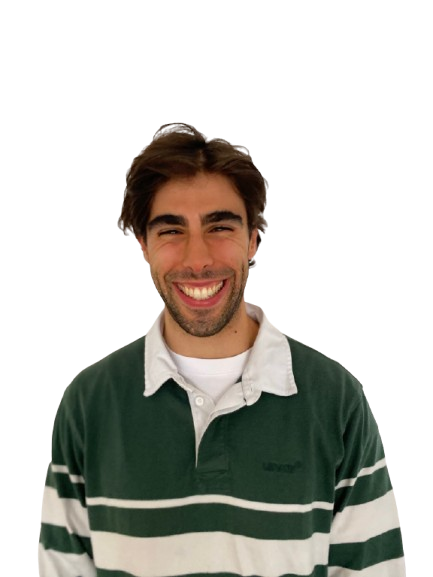
Pieter Jacobs Presenting

Hi I'm Pieter

With a background in AI, both academic and practical, I like to work at the forefront of innovation: building for start- and scale-ups through Jacobian Systems, bringing young people to them with STARTUP.CAREER, and writing about the European tech ecosystem in my articles. On this website you can explore all of this, and get to know me a bit better.

Currently Building

After two years as a Data Scientist/ML Engineer, then product manager, at OneThird, I left in August 2026 to build my own things full-time. Below you find the ventures I'm currently focused on.

STARTUP.CAREER

We inspire and enable young people to help solve the biggest problems of our time. We believe startups are the best places to do that and therefore curate Europe’s most ambitious to tell their story to people at the start of their careers. We make their missions, people, and opportunities visible, giving talent the context and access needed to act. Today, we create in-depth company profiles consisting of a short-form documentary accompanied by a long-form article. Ultimately, we’re building the platform people turn to when they want to make an impact with their careers.

Jacobian Systems

I combine an extensive technical background in AI with product experience to build and develop highly technical, AI-driven products for start- and scale-ups, from scratch to production, or to assess what they already have and what can be improved.

Currently working on ML models for hyperspectral imaging, and a computer vision product that automatically inspects fresh produce. It replaces manual visual inspection and gives distributors and growers quality insights.

Also tinkering with: Rewind

Rewind

Shared event photo vaults with a deliberate delay. Guests snap photos all night, but the pictures only develop later. The magic is in the wait.

Website

About Me

I like to use my creativity to help solve the (many) large-scale problems we are facing today. Many of these can be both depressing and frustrating to me. However, I don't enjoy sitting by and waiting for things to get worse. Instead, I like to combine my technical expertise in AI with an entrepreneurial mindset to work on solutions that make a visible impact. Making progress on this, albeit sometimes in small steps, drives me. Quite a nice feedback loop, if I do say so myself.

Learn more about me by clicking through the topics below or by going over my experience.

I've spent a ridiculous amount of time on chess and various trading card games over the years and am a proud game enthusiast. Strategizing paired with sometimes tough decision-making gets a large smile on my face (when I win). This love for games eventually introduced me to Artificial Intelligence, as various algorithms were being created in this field that aimed to automate decision making in strategy games. I was fascinated by how quickly computers learned to master these games, to the point where even human grandmasters became easy opponents. Computer chess has a history which is very fun to read about even if you don't have a technical background. Naturally, it raised many questions for me:

  • How do these algorithms work?
  • What other complex tasks could AI handle?
  • Are these models truly intelligent, and can human intelligence be replicated?

Seeking answers, I started studying in AI at the University of Groningen.

Many of my questions were answered during my BSc. and MSc. in AI, although the question on human intelligence remains great material for discussion. I learned about the fundamental principles of AI and the building blocks behind it. The various fields within AI were covered, from robotics to multi-agent systems to the now well-known machine and deep learning (because yes, these are not the same as AI but are mere parts of it). It was a lot of new information, most of which I found fascinating, especially when I could apply it practically. A lot of the now established models and algorithms were still in its early stages back then, and it's interesting to look back and reminisce about how few people really understood what my field was all about.

Nowadays, things are quite different. AI has become a buzzword, and everyone seems eager to jump on the hype. While many now think Large Language Models are equivalent to AI, people at least have some semblance of what I do. Working with AI has also become far more accessible. Any beginner programmer can, with just a few lines of code, build a neural network or some other complex model and quickly achieve acceptable results. As time goes on, this will only get easier, especially with quick advancements we see in LLMs.

So then what is my added value?

I believe it lies in having a deep understanding of what's going on behind the scene and knowing the backgrounds and purposes of the different components of what we call AI. To innovate in the field and properly apply AI, I believe it's crucial to start from first principles. This also includes understanding how the brain works and which aspects of psychology and philosophy are relevant when simulating human intelligence. These are key to answering some of the big questions we still face today.

Just to name a few:

  • What role does consciousness play in AI, or god forbid, what even is consciousness?
  • How can we develop biologically plausible AI?
  • How do humans create and learn language?
  • How can we ensure AI safety?

My goal is to regularly write about these kinds of questions and share my thoughts with you through online content. Not only because I enjoy sharing my knowledge, but also because it helps keep me sharp!

The projects I'm interested in tend to be quite ambitious. I am motivated by ideas that have the potential to have a significant positive influence on the world. Whereas I used to believe that people are quite insignificant, and won't be able to change the trajectory of the bigger picture, I have become a bit more of an optimist in recent times.

Because why not try?
There are enough examples of small groups of people going from zero to one. I believe that I am bright and that I have some talent, so why wouldn't I be able to do the same? It would be a real shame to waste my time and talent on anything less, especially now that I have the energy and mindset to take on large scale challenges. When I find a project that resonates with me, I give it everything I got.

To me, entrepreneurship is the freedom to create and build whatever I want, in whatever way I think is best. This partly comes from me being stubborn, and also from the fact that I like to have strong opinions on pretty much everything. But it's also just because of the fact that it is exciting; immediately acting on opportunities and not being too risk averse gets you into the most interesting situations. Moreover, I want to be responsible for a success or failure of something I'm working on, because this is the way I deliver and learn best. From founding my own company to driving innovation at OneThird and YAG, I plan to always continue working in entrepreneurial environments, it is a large part of who I am.

This is probably best exemplified by some fun stories from my childhood. I think most children are fully true to themselves and their actions reveal much more about their character and personality than adults' do. No, I don't want to start a nature versus nurture debate. I am merely trying to be able to use my younger self as an example of my entrepreneurial mindset. From a young age, I was always busy with ideating, making things, and selling them.

To exemplify, back in primary school I created strategy games that the entire school could participate in. I designed detailed maps of fantasy worlds where students could buy their own land. They could furnish this land with various products that I offered, which I would then neatly draw on their section of the map. But nothing in life comes for free! I decided we needed a currency so that people could pay me and trade with each other; scrap paper became the improvised money. Before long, the economy was booming, with kids trading, building, and, inevitably, waging wars against each other. War, of course, is expensive, so I quickly became a fairly wealthy individual, meaning my mother never had to worry about running out of paper for grocery lists again.

This success, along with other side hustles like my cleaning gum trade and my shop of knife-like objects made from ballpoint pens, naturally motivated me to turn more of my ideas into reality. In high school, I flipped various popular sneakers to make some money on the side and even attempted to create an MMORPG to play with my friends. Fun project, but didn't quite work out the way I envisioned it. Moreover, I decided to write a Black Mirror-esque fiction book about a monopolist trading in data (which, in hindsight, turned out to be a rather accurate prediction of today's world). My co-author and I published the book and sold it to anyone who was curious. Seeing people enjoy or benefit from the things I create has always been incredibly rewarding, and that drive has stayed with me throughout the years.

If you can clearly visualize something, I think it likely that you can also make it happen. It's a shame Conor McGregor has lost his damn mind, because he had quite a nice quote about this. The similar 'build, build, build' mantra the tech world preaches is kind of one dimensional in my opinion, but is also a good example of what I like to do. I've been making music from a young age, enjoy writing short fiction, started a humorous podcast with a good friend, and love creating customized games to play with my friends. Perhaps that's also why I like programming, because, like the aforementioned, it is a means to an end for me to build the stuff I think of.

After starting with web development, I realized that technology was a great way to express my creativity. When I had centered enough div's, I thought it time to explore other topics, such as quantum computing, AI, and the (controversial) world of crypto. I started building, and for instance invested a lot of time in building decentralized apps with Solidity. Even though it turns out that decentralization has limited use cases, I loved the process of learning a new technology.

When I find a topic that resonates with me, like the decentralized internet, I tend to lose myself in it. I'm highly competitive and love challenging myself to become the best at something, and I think this obsessive focus I have comes from that. You can clearly see it throughout my professional career but it has also shown in other endeavors. For example, when I started kickboxing, it had to be five times a week, and it was important for me to work towards an actual fight in the ring. Martial arts quickly became a new passion. Maybe an even more convincing argument, which gamers can relate to would be the fact that the Soulsborne series is my favorite.

Get in Touch

Got an exciting idea for a collaboration?
Questions about the projects I work on?
Or maybe you just want to chat about the latest tech trends?